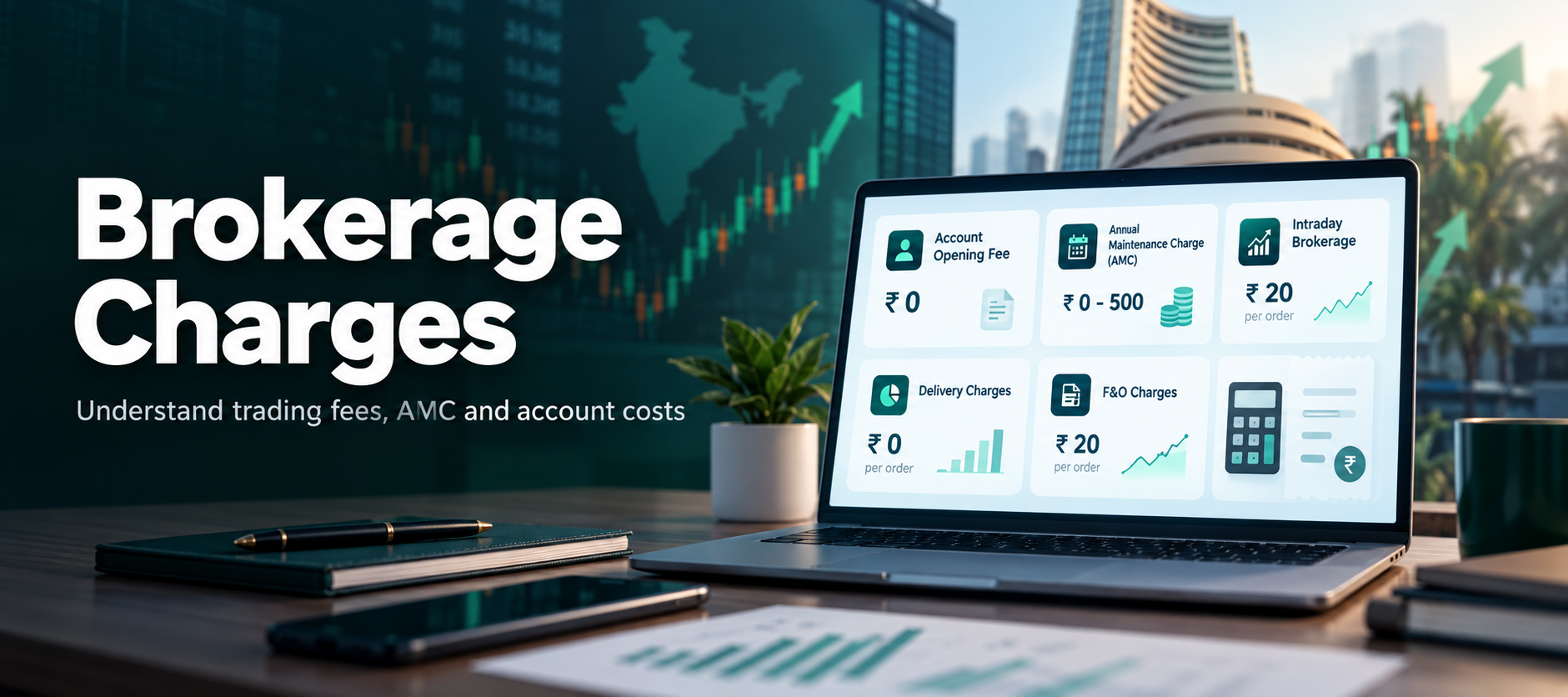
Brokerage charges are one of the most important costs to understand before opening a demat and trading account. Many investors choose a broker only by looking at headline brokerage, but the actual cost of trading can include several other charges such as demat AMC, DP charges, exchange transaction charges, GST, SEBI fees, stamp duty and call-and-trade charges.
This guide explains brokerage charges in India in a simple way so that you can compare brokers more confidently.
Important note: Brokerage plans and charges can change from time to time. Always verify the latest tariff on the broker’s official website before opening an account or placing trades.
What Are Brokerage Charges?
Brokerage is the fee charged by a stock broker for executing your buy or sell orders in the stock market.
The brokerage may be charged as:
- A flat fee per order
- A percentage of trade value
- Zero brokerage for selected segments
- A plan-based fee depending on subscription or account type
For example, discount brokers like Zerodha, Groww, Upstox, 5paisa and Dhan usually follow low-cost or flat-fee pricing models.
Full-service or bank-backed brokers like ICICI Direct, HDFC SKY, Kotak Neo, Motilal Oswal and SBI Securities may offer multiple plans with different brokerage and service benefits.
Types of Brokerage Charges
Brokerage can vary depending on the trading segment.
Common segments include:
- Equity delivery
- Equity intraday
- Equity futures
- Equity options
- Currency futures
- Currency options
- Commodity futures
- Commodity options
A broker may charge zero brokerage in one segment and a flat fee in another. That is why you should compare charges segment by segment instead of looking at only one headline number.
Equity Delivery Brokerage
Equity delivery means buying shares and holding them beyond the same trading day. These shares are delivered to your demat account.
Many discount brokers offer zero brokerage on equity delivery for eligible retail users. For example, Zerodha and Dhan advertise zero brokerage for eligible equity delivery trades.
Some brokers may charge a flat fee or percentage-based brokerage on delivery trades. Before choosing a broker, check whether delivery brokerage is zero, flat-fee based or percentage-based.
Intraday Brokerage
Intraday trading means buying and selling shares on the same trading day.
Intraday brokerage is usually different from delivery brokerage. Brokers may charge:
- Flat brokerage per executed order
- Percentage of trade value
- Lower of flat fee or percentage
- Plan-based brokerage
For active traders, intraday brokerage matters because frequent trades can increase total cost. Brokers like Zerodha, Upstox, Groww, 5paisa and Dhan are commonly compared by intraday traders because of their online-first pricing models.
Futures and Options Brokerage
F&O traders should pay special attention to brokerage and other statutory charges because frequent trading can make costs add up quickly.
Options brokerage is often charged on a per-order basis. Futures brokerage may be charged as a flat fee or a percentage, depending on the broker’s plan.
Before trading in F&O, compare:
- Brokerage per executed order
- Exchange transaction charges
- GST
- STT
- SEBI charges
- Stamp duty
- Call-and-trade charges
- Platform stability and execution quality
Low brokerage is useful, but for F&O traders, platform reliability and order execution quality are equally important.
Account Opening Charges
Some brokers charge an account-opening fee, while others offer free account opening as part of promotional plans.
Many online brokers such as Groww, Dhan, Angel One and HDFC SKY often advertise zero account-opening charges, subject to current offers and account terms.
Always check whether the account-opening charge is permanently free or part of a limited-period offer.
Demat AMC Charges
Demat AMC means annual maintenance charge for maintaining your demat account.
This charge can be:
- Free
- Charged annually
- Charged monthly
- Waived for the first year
- Based on BSDA eligibility
- Based on account type or plan
For long-term investors, demat AMC is important because it is a recurring cost even if you do not trade frequently.
Before opening an account, check:
- First-year AMC
- AMC from second year onward
- BSDA eligibility
- Monthly vs annual billing
- Other demat-related charges
DP Charges
DP charges are charged when shares are debited from your demat account. This usually applies when you sell delivery shares.
Many beginners ignore DP charges while comparing brokers. But if you sell delivery holdings frequently, DP charges can affect your total cost.
DP charges vary by broker and depository setup, so always check the broker’s tariff sheet.
Call and Trade Charges
Call and trade charges apply when you place orders through a dealer or customer support team instead of placing them yourself online.
Some brokers charge extra for call-and-trade orders. This may matter if you are not comfortable placing orders online or if you sometimes need dealer assistance.
Full-service brokers may offer more assisted services, while discount brokers generally encourage users to trade through online platforms.
MTF Interest Cost
MTF stands for Margin Trading Facility. It allows investors to buy eligible stocks using partial funding from the broker.
MTF cost is not brokerage, but it is an important trading cost. If you use margin funding, the interest rate can be more important than brokerage.
For example, HDFC SKY, Groww, Dhan, FYERS and other brokers may offer MTF with different interest rates, eligible stock lists and margin rules.
Before using MTF, compare:
- Interest rate
- Eligible securities
- Maximum funding
- Pledge requirements
- Brokerage
- Risk rules
- Square-off conditions
MTF can magnify both gains and losses, so it should be used carefully.
Discount Brokers vs Full-Service Brokers
Discount brokers usually focus on low brokerage and digital platforms. They are popular among self-directed investors and active traders.
Examples include Zerodha, Groww, Upstox, 5paisa, Dhan and FYERS.
Full-service brokers may offer research, advisory, relationship support, branch support and broader financial services.
Examples include ICICI Direct, Motilal Oswal, SBI Securities, HDFC Securities and Kotak Securities.
The right choice depends on whether you want low cost, research support, banking integration or personal assistance.
Brokerage Is Not the Only Cost
When comparing brokers, do not look only at brokerage. Your total cost may include:
- Brokerage
- Demat AMC
- DP charges
- Exchange transaction charges
- GST
- STT
- SEBI charges
- Stamp duty
- Auto square-off charges
- Call-and-trade charges
- MTF interest
- Payment gateway or fund transfer charges, if applicable
A broker with low brokerage may still be costly for your use case if other charges are high.
How to Compare Brokerage Charges
Before selecting a broker, ask these questions:
- Do I mostly invest or trade?
- Do I need equity delivery brokerage to be zero?
- How often will I trade intraday?
- Will I trade in F&O?
- Do I need research and advisory?
- Will I use MTF?
- Do I need bank integration?
- Am I comfortable with online-only support?
- What is the total annual cost including AMC and DP charges?
If you are a long-term investor, delivery brokerage, AMC and DP charges may matter more. If you are an active trader, intraday/F&O brokerage, platform speed and execution quality may matter more.
Final Thoughts
Brokerage charges are important, but they should be compared along with platform quality, account charges, customer support, research, MTF cost and overall suitability.
For low-cost trading, brokers like Zerodha, Groww, Upstox, 5paisa and Dhan are commonly compared.
For research, banking ecosystem and full-service support, brokers like ICICI Direct, HDFC SKY, Kotak Neo, Motilal Oswal and SBI Securities may be worth evaluating.
The best broker is not always the cheapest broker. The best broker is the one that matches your actual investing or trading requirement.
Disclaimer: This article is for educational and comparison purposes only. Brokerage charges, taxes, MTF rates and account fees may change. Please verify the latest tariff directly from the broker’s official website before opening an account or placing trades.